The first hard frost of the season usually arrives with the same question attached: is my road going to be gritted, or am I on my own with a shovel and a bag of salt? In Norfolk the answer is written down, published, and easy enough to check once you know where to look. It helps to understand one thing before you start: not every street is on the list, and no council anywhere grits every road. What follows is how the system actually works, how to find out where you sit in it, and what to do if you think your corner of the county has been overlooked.
Who grits what, and why it matters
Norfolk County Council is the highways authority for most of the county, which means it decides which roads get treated and sends the gritters out. There are exceptions. The A47 and the A11 are trunk roads managed by National Highways, so if you live alongside one of those, the county's map is not the whole story. Private roads, unadopted lanes and driveways are not gritted by anyone but the people who use them.
Beyond that, the county divides its roads into groups. In practice, that means:
- Primary routes — A-roads, main routes into towns, key bus corridors and links to hospitals. These are treated first and most often.
- Secondary routes — busier B-roads and important connections between villages, treated when conditions are bad enough.
- Everything else — most residential streets, cul-de-sacs, narrow lanes and estate roads. These are usually left untreated, however frosty they get.
That last category is where most arguments start. A street can look busy to the people who live on it and still sit well down the priority list, because the list is built around traffic volumes, bus routes and emergency access rather than how many wheelie bins appear on a Tuesday.
Find the map in a few minutes
Search the county council's website for "winter gritting" or "gritting routes" and you will land on the winter service pages. From there you want the interactive gritting map, which lets you type in a street name or postcode and see whether it falls inside a treated route.
A couple of tips for reading it:
- Zoom in far enough that the coloured route lines separate. At county-wide zoom, everything looks connected.
- Check whether the treated line runs along your street or merely crosses the end of it. A gritted main road at the bottom of a hill does nothing for the hill itself.
- Look at the route nearest to you and work out where it goes. If it stops at the edge of a village, that tells you the village centre is on the network and the outlying lanes are not.
The same pages usually carry the council's winter service policy or plan, which sets out the rules behind the map. It is dry reading, but it answers the question "why not my road?" more honestly than any forum thread will.
When the gritters actually go out
Crews do not wait for snow. Most runs are precautionary salting, sent out before temperatures drop, so the salt is already on the surface when it starts to freeze. Decisions are normally taken through the evening and night, using forecasts and road surface temperature readings from weather stations around the county. On a typical frosty night, gritters roll out from depots late in the evening and continue into the early hours, working the primary network first and moving on to secondary routes if there is time and the forecast justifies it.
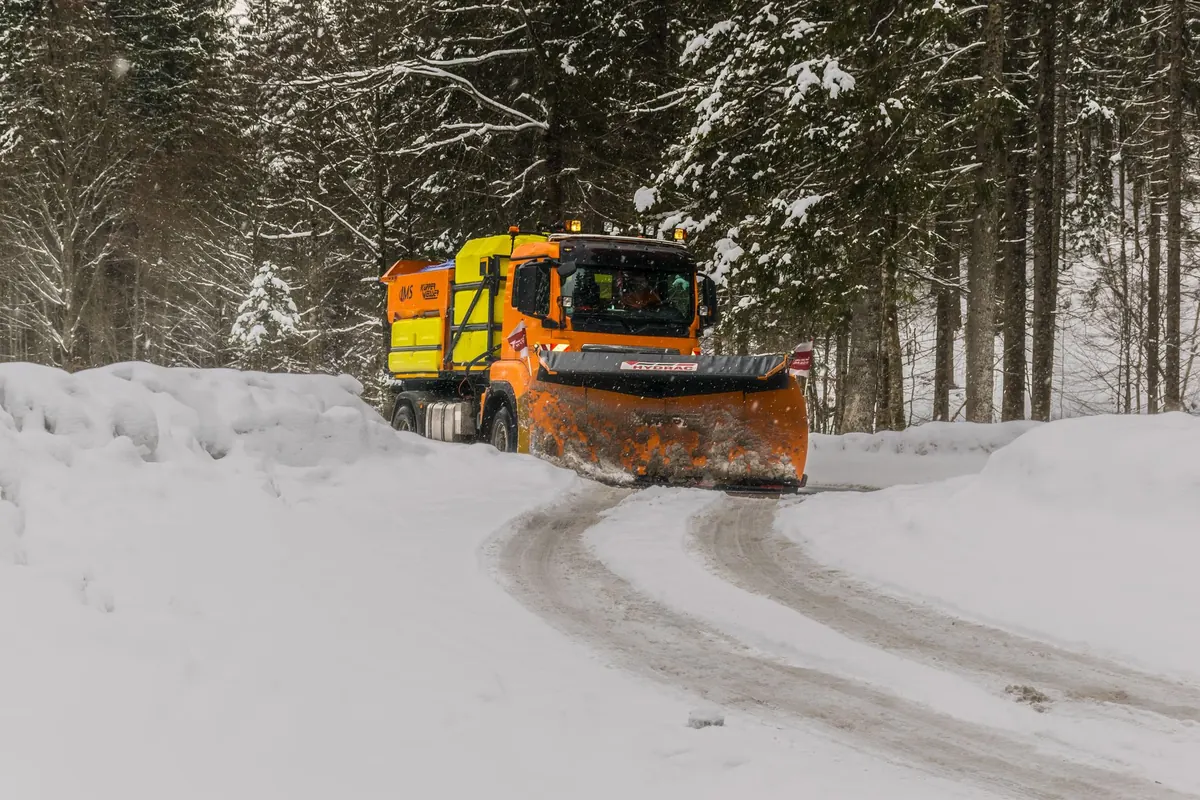
Once snow is falling or ice has already formed, the job changes. Ploughs go on, crews run longer shifts, and priority routes get repeated treatment. Farmers and contractors are sometimes called in with their own equipment to help clear rural roads.
Two things are worth knowing. Salt needs traffic to work properly — it is the passing of tyres that grinds it into the surface and turns it into brine. On a quiet lane at 2am, even a gritted road can stay slippery. And in genuinely severe cold, salt loses much of its effect, which is why a treated road is not a guarantee.
Salt bins: where they come from and how to ask for one
Salt bins are a common source of confusion. Some are provided and refilled by the county council; plenty of others are bought and maintained by parish and town councils, or by community groups. If a bin near you is empty, find out who owns it before chasing the wrong organisation.
To request one, the usual route is:
- Check the gritting map first. If your street is on a treated route, a bin is unlikely to be granted.
- Find the right contact — the county council's highways team for a county bin, or your parish or town council if the request is local.
- Explain the site: a steep junction, a bend, a footpath to a school, a sheltered spot that ices over early.
- Suggest a location that is visible and accessible to a small vehicle, and say who would use it.
- Ask about refills at the same time. A bin with no plan for restocking is decoration.
Salt from a public bin is intended for public roads and footways, not private driveways. Taking a bucketful for your own path is the sort of thing that gets a bin removed.
If your street is not on the route
Most Norfolk residents live off the treated network, and life carries on regardless. A few practical habits make a real difference: clear snow from your own frontage before it compacts into ice, keep gullies and drains at the kerb free of leaves so melting snow has somewhere to go, and check on neighbours who are less steady on their feet. Parish councils often organise volunteer snow wardens or a shared stock of salt, and a note in a village newsletter can achieve more than a complaint to the county.
The short version
Look up the county's gritting map, type in your postcode, and see whether your street is inside a coloured route — that single check settles most of the argument. Remember that primary routes come first, that salt needs traffic and reasonable temperatures, and that untreated streets are normal rather than a mistake. If you think a junction or path near you needs a salt bin, contact the county council or your parish council with a clear reason and a sensible location. And keep a bag of salt, a decent shovel and a good pair of boots within reach. In Norfolk, that is not pessimism. It is preparation.
Photo: Thomas H. / Pexels